You can often tell a jump went wrong before the measurement is called. The run-up gets choppy over the last few strides, the athlete stretches for the board, and the landing leaves half a metre in the pit. None of it looks dramatic, which is exactly why these habits stick around for seasons at a time.
The good news is that most lost distance comes from a handful of repeatable mistakes. Fix two or three of them and your personal best usually follows.
Reaching for the Board
This is the most common error at every level. The athlete senses the board is close, takes a longer final stride, and plants the takeoff foot well in front of the hips. That stretched plant acts like a brake. Speed drops before the foot leaves the ground, and the jump is slow and usually a foul as well.
Reaching is rarely a technique problem on its own. It is a symptom of a run-up that is not reliable, so the athlete has to negotiate the board at the last second. The fix is to set your approach so that your normal rhythm puts the takeoff foot on the board without any late adjustment. If you are consistently short, move your starting mark back a foot. If you are consistently over, move it forward. Change the start, never the last three strides.
A simple cue helps: run off the board, not to the board. And stop glancing down at it. Looking at the board tips your head and shoulders back, which shortens your posture and slows you down at the worst possible moment.
An Inconsistent Run-Up
Two athletes can run the same 18 strides and arrive at completely different places. That happens when the start is sloppy. Standing up too early, changing which foot goes first, drifting in the first few steps, or wandering sideways all shift the whole run-up by half a metre or more.
Build the approach the same way every time. Walk back from the board to find your start, then mark it. From there, keep the first four steps identical: same foot forward, same body angle, same amount of push. Rhythm matters more than raw speed in the early strides, because a rushed start flattens your acceleration later.
Useful habits for making the run-up repeatable:
- Mark your start and a mid-point, and check both before every jump.
- Have a coach or teammate watch your takeoff foot and note where it lands relative to the board.
- Time the last 10 metres of your run-up occasionally. If you are slowing down, you will see it in the splits.
- Repeat your full run-up four to six times in a session without jumping, just to check consistency.
- Keep a note of your marks for each track you use. Surfaces, wind and even your mood change the numbers slightly.
Wind and fatigue will move your mark a little, so make small adjustments of 10 to 20 centimetres, not big ones. Never rebuild your run-up in the middle of a competition.
Slowing Down Before Takeoff
Many jumpers get the run-up right and then waste it in the final two strides. The penultimate stride should be slightly longer, with the last stride shorter and quicker. Instead, the last stride often becomes the longest, the heel lands first, and the whole body brakes.
Think tall and fast through the board. Stay upright, keep ground contact short, and let the free knee drive forward and up. If you can hear a heavy thud on the board, you are planting rather than striking, and you are giving away speed.
Short-approach pop-ups — three to five strides into a takeoff — are the best drill here. They force you to practise a quick, springy plant without the pressure of a full approach.
Takeoff Mechanics That Leak Distance
The takeoff is not a vertical jump. You are converting horizontal speed into a longer, higher arc, and you need some height to stay in the air long enough to set up the landing. Two errors ruin that: bending at the waist so the chest drops, and collapsing the takeoff knee so the body sinks into the board.
Stay tall through the plant and let the leg extend as you leave the ground. A slight forward lean from the ankles is fine; folding at the hips is not. Bounding, wicket runs and short-approach jumps all train this pattern without hammering your legs.
Poor Landing Mechanics
Landings are where the quietest losses happen. Two mistakes show up constantly.
The first is reaching the legs out far too early while the hips drop behind. The heels touch the sand, but the body's weight is already behind them, so you fall back and lose the distance your heels earned. Extend the legs late, not early.
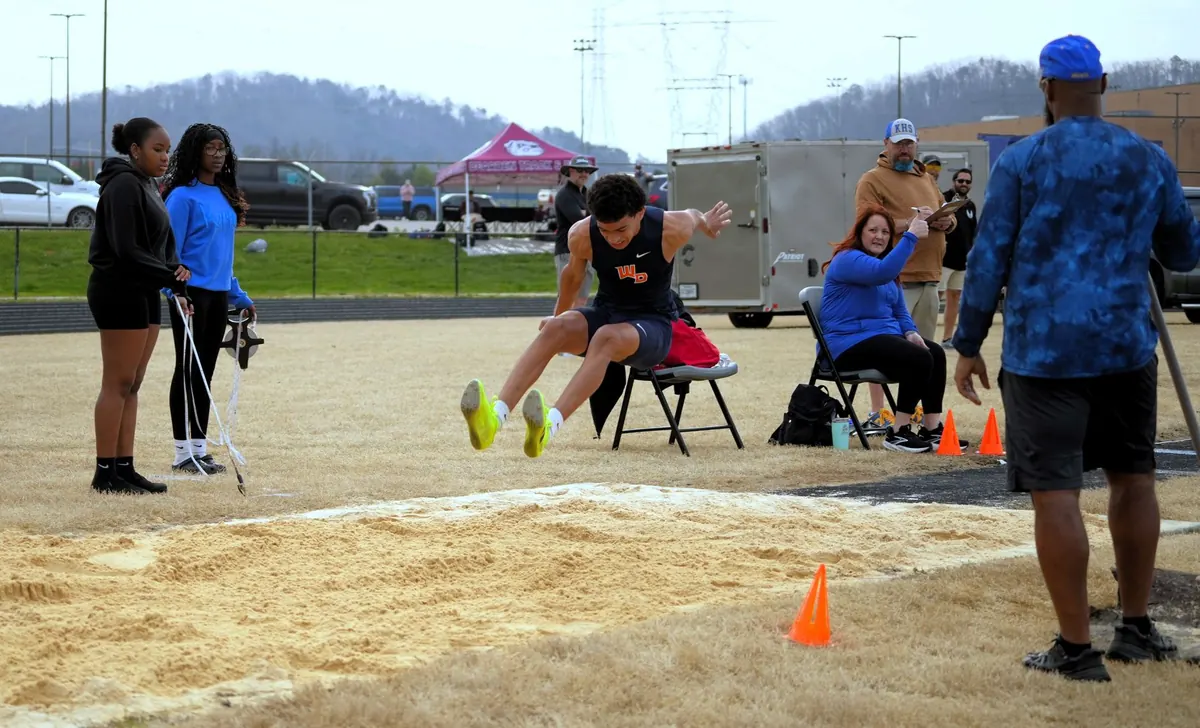
The second is sitting back or letting the arms swing behind after touchdown. Your hips should keep travelling forward at the moment your heels hit. Sweep the arms down and back as the legs reach out, then drive them forward past your hips as you touch down. That motion pulls your torso forward instead of letting it collapse backwards.
Practise landings from a short approach so you get plenty of repetitions without the pounding of full-speed jumps. Standing long jumps with a target in the sand are also useful: pick a spot beyond where you normally land and try to put your heels on it while keeping your hips moving. And resist the urge to look at your feet — the head drops, and the hips follow it down.
Practice Habits That Hold You Back
Volume is the most common training mistake. Twenty full-approach jumps will leave you flat, slow and sore, and every one after the tenth teaches you a bad habit. Six to eight quality full jumps, plus drills, is plenty for most sessions.
Long jump is a sprint event, so speed work belongs in your week. If your 30-metre time is not improving, your run-up speed is capped and no amount of technical tweaking will fix it. Film yourself as well: a side view at the board and the landing tells you more in ten seconds than a whole session of guessing.
If you are managing knee, ankle or heel pain, cut the volume and get it looked at by a physiotherapist or doctor rather than pushing through.
A Practical Fix Plan for Your Next Session
- Warm up thoroughly, then run three or four accelerations of 20 to 30 metres from your usual start position.
- Take four to six full run-ups without jumping and record where your takeoff foot lands each time.
- Do four to six short-approach jumps of five to seven strides, focusing on tall posture and a quick plant.
- Finish with three or four full jumps, thinking only about the landing and keeping your hips moving forward.
- Write down your marks, the wind direction and one thing you noticed. Bring it to the next session.
Work on one mistake at a time and give it two or three weeks before you judge it. Chasing three fixes at once usually means mastering none of them. The jumpers who improve fastest are rarely the ones doing something spectacular — they are the ones who stopped losing the same half metre every time.
Photo: Chris L / Pexels